
Gut Health and Chronic Disease: What’s the Connection?
Gut Health and Chronic Disease: What’s the Connection?
Key takeaways
- Gut health can influence chronic disease risk by shaping inflammation, immune signaling, and metabolic function.
- The microbiome produces compounds that affect the gut barrier and can influence organs far beyond digestion.
- When the intestinal barrier is impaired, immune activation and systemic inflammation can increase.
- Diet pattern, medications (especially antibiotics), sleep, stress, and activity levels all impact microbiome function.
- Gut-focused strategies work best as part of an overall chronic disease plan, not as a stand-alone “fix.”
Many chronic diseases don’t start where symptoms show up. Increasingly, research points to the gut—especially the microbiome, intestinal barrier, and immune signaling—as a place where long-term inflammation and metabolic disruption can begin. If you’re new to the bigger picture, start with Digestive and Immune Disorders: How Gut Health Affects the Whole Body, which explains how gut function connects to immune regulation across the body.
What “Gut Health” Really Means in a Chronic Disease Context
“Gut health” can sound vague, so it helps to define it in practical terms. In the context of chronic disease, gut health usually refers to how well these systems are functioning together:- Microbiome balance: diversity, stability, and function of gut microbes
- Intestinal barrier integrity: how effectively the gut lining regulates what enters the bloodstream
- Immune tolerance and control: whether gut immune tissues respond appropriately (not too much, not too little)
- Digestive performance: motility, enzyme activity, bile function, and nutrient absorption
The Microbiome as a “Metabolic Organ”
Gut microbes don’t just live in you—they actively process what you eat and generate biologically active compounds. Some of these support health, while others can be harmful depending on diet pattern, microbial composition, and overall health status.Helpful outputs: short-chain fatty acids
When microbes ferment certain fibers, they produce short-chain fatty acids (SCFAs) like butyrate. SCFAs help:
- fuel colon cells
- support the mucus layer that protects the gut lining
- influence immune regulation and inflammatory signaling
- affect metabolic pathways involved in insulin sensitivity
Harmful outputs (context-dependent)
Some microbial metabolites can contribute to disease risk depending on the overall pattern. For example:- Endotoxin-related immune activation can increase if gut barrier function is impaired and certain bacterial components enter circulation.
- Certain metabolites associated with diet patterns high in specific animal foods have been studied in relation to cardiovascular risk.
The Gut Barrier: Why It Matters Beyond Digestion
The intestinal lining is designed to be selectively permeable: it should allow nutrients through while limiting passage of pathogens and inflammatory molecules. When barrier function is weakened (often discussed as increased intestinal permeability), the immune system may be exposed to more inflammatory triggers.This can lead to:
- higher inflammatory signaling
- greater immune reactivity
- worsening metabolic control in susceptible individuals
Chronic Inflammation: A Shared Pathway Across Many Conditions
Many chronic diseases—such as type 2 diabetes, cardiovascular disease, fatty liver disease, and some autoimmune conditions—share a common feature: persistent, low-grade inflammation.
- microbial metabolites (supportive or pro-inflammatory depending on context)
- immune training and tolerance in gut-associated lymphoid tissue
- barrier integrity and antigen exposure
- signaling through the gut–brain axis (stress and autonomic regulation)
Where the Evidence Is Strongest
Because chronic diseases are multi-factorial, the strongest evidence tends to appear in areas where gut-related interventions influence well-measured risk markers (not necessarily “cure” outcomes).Cardiometabolic disease
Associations are strongest around:- diet patterns that support microbial diversity (fiber-rich, minimally processed diets)
- SCFA-related mechanisms and inflammation markers
- metabolic outcomes like insulin sensitivity and lipid profiles
Inflammatory conditions
Inflammatory bowel disease (IBD) is the clearest example where immune and microbiome factors are central, but inflammation-related pathways are also studied across broader chronic disease categories.Liver health
The “gut–liver axis” is a major research focus, especially in metabolic-associated fatty liver disease, where inflammation and metabolic dysfunction overlap.Why Symptoms Don’t Always Match the Underlying Issue
One confusing aspect of gut health is that chronic disease connections can exist even when symptoms are mild. That happens because:- immune activation can be low-grade and ongoing without obvious GI distress
- microbiome function can shift while digestion still “seems fine”
- barrier changes don’t always cause immediate, noticeable symptoms
- systemic effects (fatigue, skin flares, metabolic changes) may show up first
This is why it’s often more useful to think in terms of systems biology than isolated symptoms.
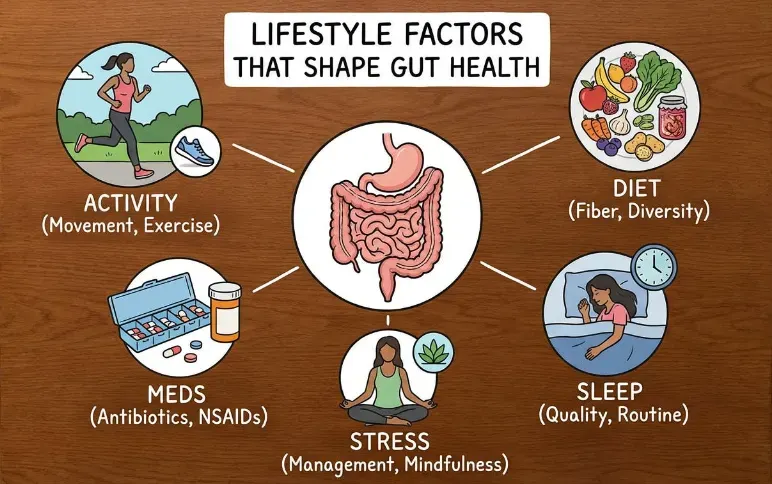
Practical Factors That Shape Gut Health Over Time
There isn’t one “perfect” gut protocol, but there are consistent, evidence-aligned levers that influence gut function and chronic disease risk markers.Diet pattern (the biggest lever for most people)
Helpful patterns tend to include:- a variety of fiber sources (vegetables, legumes, whole grains, nuts, seeds)
- fermented foods as tolerated (yogurt/kefir, kimchi, sauerkraut)
- adequate protein and healthy fats
- minimized ultra-processed foods and excess added sugar
Medication and antibiotic history
Antibiotics can be necessary and lifesaving, but they can also disrupt microbial balance. If antibiotics are required, it can be helpful to focus afterward on:- diet quality and fiber diversity
- sleep and stress regulation
- gradual reintroduction of fermented foods if tolerated
Sleep and circadian rhythm
Poor sleep alters inflammatory signaling and can shift appetite regulation and metabolism—factors that indirectly affect the gut.Stress physiology
Stress can affect motility, sensitivity, and gut–brain signaling. Chronic stress doesn’t “cause” chronic disease alone, but it can amplify inflammatory and metabolic strain.Physical activity
Moderate, consistent movement is associated with better metabolic health and may support microbial diversity, though intensity and recovery matter.Putting It Together: A Realistic View of the Gut–Chronic Disease Link
Gut health isn’t a miracle switch, and chronic disease prevention or management should never be reduced to one organ system. But the gut is a meaningful “control hub” because it influences:- inflammation and immune calibration
- metabolic signaling and energy balance
- barrier function and systemic exposure to inflammatory triggers
References
- National Institutes of Health (NIH) Human Microbiome Project: overview of microbiome research and health relevance
- Belkaid Y, Hand TW. “Role of the microbiota in immunity and inflammation.” Cell
- Koh A, De Vadder F, Kovatcheva-Datchary P, Bäckhed F. “From dietary fiber to host physiology: short-chain fatty acids as key bacterial metabolites.” Cell
- Fasano A. “Zonulin, regulation of tight junctions, and autoimmune diseases.” Annals of the New York Academy of Sciences
- Tilg H, Zmora N, Adolph TE, Elinav E. “The intestinal microbiota fuelling metabolic inflammation.” Nature Reviews Immunology