
Is Tap Water Bad for Your Health? The Hidden Chemicals, Real Risks, and Affordable Fixes
Is Tap Water Bad for Your Health? The Hidden Chemicals, Real Risks, and Affordable Fixes
Key takeaways
- Tap water often contains low-dose contaminants like fluoride and DBPs that may affect hormone and thyroid health.
- Affordable filtration options — from pitchers to countertop systems — can significantly reduce exposure to harmful compounds.
- Letting tap water sit uncovered is a free method to remove some contaminants when no filter is available.
Most of us don't think twice about filling a glass from the kitchen sink. It’s convenient, cheap, and in most places, tastes just fine. But just because your water looks clear doesn’t mean it’s clean — at least not in a way that supports long-term health. Municipal water supplies meet basic safety standards, yes. But “safe” doesn’t always mean optimal, and the reality is that tap water often contains trace compounds that science increasingly connects to hormone disruption, lowered fertility, thyroid issues, and more.
The Hidden Chemicals in Tap Water Most People Don’t Know About
Tap water is treated to prevent immediate dangers like bacteria or sewage exposure — and rightly so. But the flip side of treatment is the use of chemicals that leave behind residues called disinfection byproducts (DBPs). These are formed when disinfectants like chlorine react with natural organic matter in the water supply. And while they’re legal, research links them to concerning biological effects.
In many areas, tap water also contains endocrine-disrupting chemicals (EDCs). These compounds interfere with hormonal function and are increasingly recognized as culprits in everything from reproductive issues to metabolic disorders. They might not make you sick overnight, but chronic exposure over time adds up — especially if you’re already dealing with hormonal imbalances or autoimmune issues.
Why Endocrine Disruptors in Water Are More Serious Than They Sound
The term endocrine disruptor doesn’t exactly scream danger, but its impact can be far-reaching. EDCs can mimic or block natural hormones in the body, leading to disruptions in reproductive health, thyroid function, and even brain chemistry. A 2020 global review titled "Endocrine Disruptors in Water and Their Effects on the Reproductive System" laid it out plainly: many municipal water sources, even in developed countries, contain enough EDCs to raise red flags.
The Role of Fluoride in Tap Water — And Its Impact on Thyroid Health
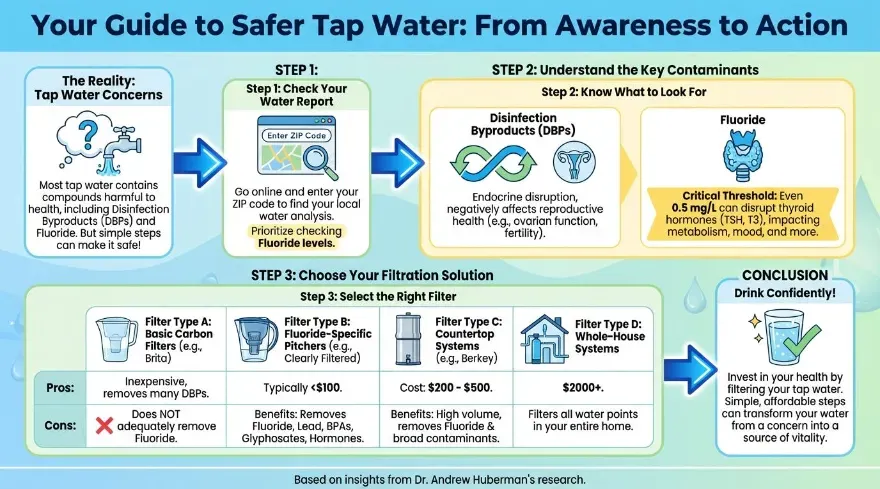
Fluoride has long been added to tap water to reduce dental cavities — and while it might benefit teeth, the rest of the body isn’t quite as fond of it. One of the more well-documented concerns? Its effect on thyroid function. A 2018 case-control study titled “Impact of Drinking Water Fluoride on Human Thyroid Hormones” found that even levels as low as 0.5 mg/L could alter T3 and TSH levels — especially in people with a family history of thyroid dysfunction.
DBPs: What Disinfection Byproducts Really Do to Your Body
The purpose of water disinfection is noble — we don’t want cholera or E. coli in the water system. But in solving one problem, we’ve introduced another. Disinfection byproducts such as trihalomethanes and haloacetic acids form during chlorination and have been shown to interfere with reproductive hormones in both men and women.
How to Find Out What’s in Your Tap Water
Curious about your own water quality? You should be — and it’s easier to check than you might think. Websites like EWG’s Tap Water Database
allow you to input your ZIP code and review detailed reports on contaminants, including DBPs, fluoride, nitrates, and more.Your local water utility is also required to publish annual Consumer Confidence Reports (CCRs) that list water quality metrics. While the numbers can be confusing, pay close attention to:
- Fluoride concentration (over 0.5 mg/L = red flag)
- Total trihalomethanes (TTHMs)
- Haloacetic acids (HAAs)
- Lead and arsenic levels
- If you see words like “average” or “within legal limit,” don’t assume it means “healthy.” Legal doesn’t always mean safe — just as low-grade exposure doesn’t mean harmless.
Affordable Ways to Make Tap Water Safer to Drink
The idea that cleaner water means thousands of dollars in upgrades is simply outdated. The truth is, there are low-cost filtration solutions that make a meaningful difference. Basic carbon filters (think Brita-style) can reduce chlorine taste and some DBPs — but they typically don’t remove fluoride or more stubborn contaminants.
Pitcher filters designed to remove fluoride (such as the Clearly Filtered brand) are a good entry point. They cost under $100, last for several months, and require minimal effort. Yes, you’ll need to replace the filters — but the health tradeoff is worth it. For many, it’s the best balance between affordability and function.
The Best Home Water Filters That Actually Remove Fluoride and Contaminants
For those wanting to step it up, gravity-fed countertop systems like Berkey filters offer higher capacity and more complete filtration. These don’t need electricity, filter out a wide range of contaminants including fluoride, and cost between $250–$400. It’s a one-time investment that pays off quickly if you’re drinking a lot of water.
If budget isn’t a concern, whole-house filtration systems can remove contaminants from every faucet, including your shower. These systems typically start at $1,500–$2,000 and offer peace of mind for those with serious health concerns or immune conditions. Think of them as home infrastructure upgrades — like installing a water heater, but for your endocrine system.
No-Budget? Here’s a Practically Free Way to Improve Your Tap Water
If you can’t afford a filter right now, there’s still something you can do: let your tap water sit in an open container for 12–24 hours at room temperature. This allows some volatile compounds and chlorine to dissipate, and sediment to settle. Pour off the top two-thirds for drinking, and discard the rest.
It’s not a perfect solution — fluoride and many EDCs won’t fully evaporate. But it does reduce exposure to pipe-borne particles and some chemical residues. If you’re in an older building with questionable plumbing, this simple method can help reduce your daily toxic load, especially when combined with awareness of your water source.
Final Thoughts on Drinking Tap Water and Protecting Your Health
Tap water isn't the villain — but it's not the hero either. It's functional, widely accessible, and better than nothing. Still, the silent buildup of compounds like fluoride and DBPs can create health ripple effects over time. For people with thyroid issues, fertility concerns, or autoimmune tendencies, filtering your water isn’t a luxury — it’s a smart, preventative move.Fortunately, the solutions don’t have to break the bank. From basic pitchers to sophisticated countertop systems, you can protect your body from contaminants without giving up the convenience of tap. And whether you filter or not, knowing what’s in your water is the first step to drinking — and living — smarter.
References:
· https://www.ncbi.nlm.nih.gov/pmc/articles/PMC5805681/
· https://pubmed.ncbi.nlm.nih.gov/38029816/
· https://journalistsresource.org/economics/fluoride-research-roundup/
· https://en.wikipedia.org/wiki/Haloacetic_acids
· https://jamanetwork.com/journals/jamapediatrics/fullarticle/2828425