
How Exercise Impacts the Body: Muscles, Hormones, and Metabolism
How Exercise Impacts the Body: Muscles, Hormones, and Metabolism
Key takeaways
- Exercise creates controlled stress that stimulates muscle growth and metabolic adaptation.
- Hormonal responses to training regulate energy use, recovery, and tissue repair.
- Consistent training improves insulin sensitivity, mitochondrial density, and overall metabolic efficiency.
Exercise as a Biological Signal
Exercise is a form of structured physical stress. When you lift weights or perform cardiovascular activity, you temporarily disturb the body’s internal balance. Oxygen demand rises, muscle fibers experience mechanical tension, and energy stores are depleted.In response, the body activates signaling pathways that promote repair and adaptation. These changes make future efforts more efficient. This adaptive process is the foundation of how training improves strength and long-term health, as outlined in The Complete Guide to Exercise: How Training Improves Strength, Health, and Longevity
.How Exercise Affects Muscles
Mechanical Tension and Muscle Fiber Recruitment
During resistance training, muscle fibers experience tension as they contract against load. The nervous system recruits motor units based on the intensity of the effort. Higher intensity work recruits larger, fast-twitch fibers.Microdamage and Repair
Exercise creates small-scale structural disruption within muscle fibers. This is normal and necessary. Inflammatory signals trigger repair processes, increasing protein synthesis and strengthening the tissue.Muscle Fiber Type Adaptation
Endurance training encourages adaptations in slow-twitch fibers, improving fatigue resistance. Resistance training improves the strength and size of fast-twitch fibers. Both adaptations are useful. Together, they improve overall functional capacity.Hormonal Responses to Exercise
Hormones act as messengers that coordinate how the body responds to training stress.Acute Hormonal Changes
During and immediately after exercise, several hormones rise:- Adrenaline and noradrenaline increase heart rate and energy availability.
- Growth hormone supports tissue repair.
- Testosterone contributes to muscle protein synthesis.
- Cortisol mobilizes energy stores.
Long-Term Hormonal Regulation
With consistent exercise, baseline hormonal function can improve:- Increased insulin sensitivity
- Better glucose regulation
- Improved appetite signaling
- More stable stress responses
Exercise and Metabolism
Metabolism refers to all chemical processes that convert nutrients into usable energy.Energy Systems in Action
The body relies on three primary energy systems during exercise:- ATP-PC system for short, explosive efforts
- Glycolytic system for moderate-duration high-intensity work
- Oxidative system for longer, lower-intensity activity
Mitochondrial Adaptation
Endurance training increases mitochondrial density inside muscle cells. Mitochondria are responsible for aerobic energy production. More mitochondria mean:- Greater endurance capacity
- Improved fat oxidation
- Better metabolic flexibility
Insulin Sensitivity and Glucose Control
Exercise increases the ability of muscle cells to absorb glucose from the bloodstream. This effect occurs both acutely and chronically.The Nervous System and Coordination
Although less visible, the nervous system adapts quickly to training. Early strength gains often result from:- Improved motor unit recruitment
- Better coordination between muscle groups
- More efficient movement patterns
Inflammation and Recovery
Exercise temporarily increases inflammatory markers. This is part of the repair process. With proper recovery:- Inflammation resolves
- Tissue repairs
- Adaptation strengthens the system
The Integrated Effect
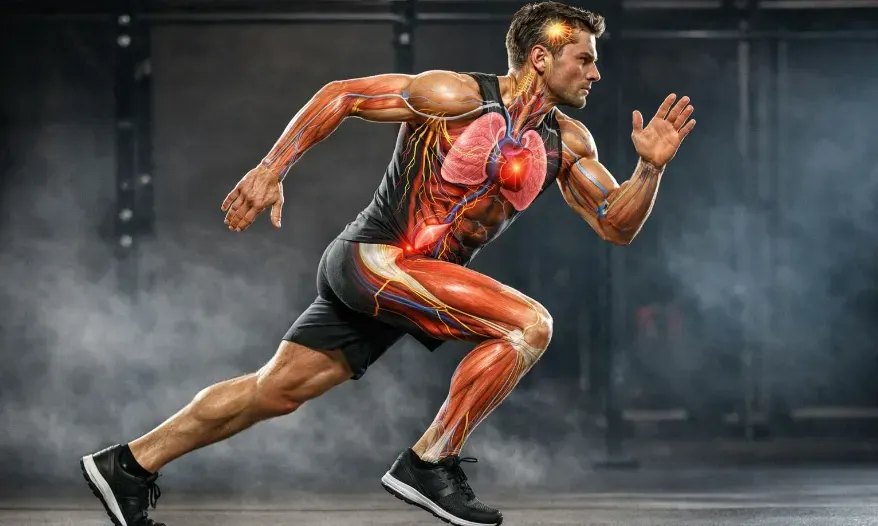
Muscles, hormones, and metabolism do not operate independently. They function as a coordinated system. When you train:- Muscles generate mechanical stress
- Hormones regulate energy and repair
- Metabolism adapts to meet energy demands
- The nervous system improves efficiency
Why These Adaptations Matter
Understanding how exercise affects the body provides clarity on why consistency matters.- Improved cardiovascular health
- Increased muscle strength
- Better metabolic regulation
- Reduced disease risk
- Enhanced functional capacity with aging
References
- American College of Sports Medicine. Position Stand: Progression Models in Resistance Training for Healthy Adults.
- Booth FW, Roberts CK, Laye MJ. Lack of exercise is a major cause of chronic diseases. Comprehensive Physiology.
- Hawley JA, et al. Integrative biology of exercise. Cell.
- Pedersen BK, Saltin B. Exercise as medicine. Scandinavian Journal of Medicine and Science in Sports.